
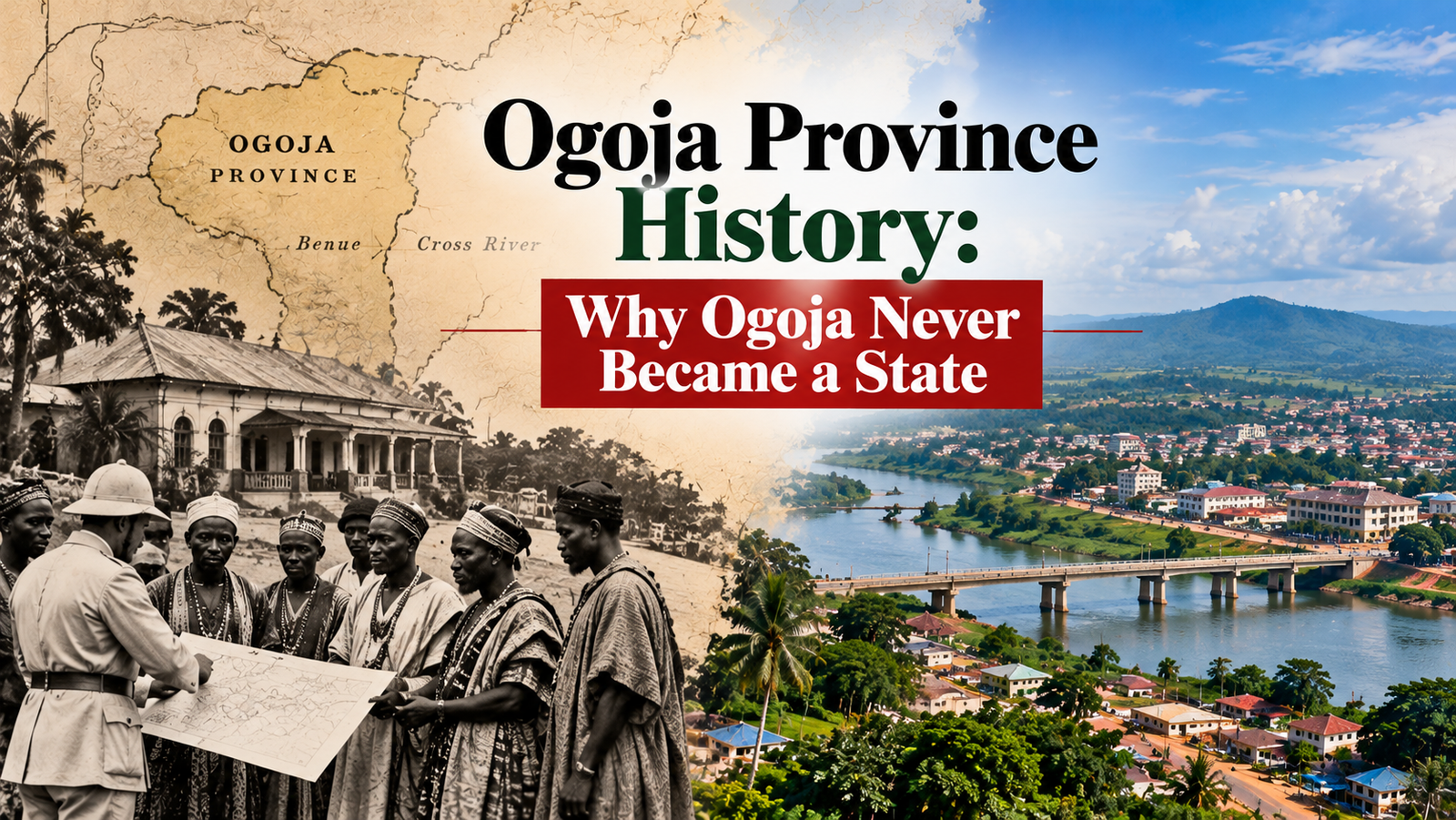
There is a striking contradiction in Nigeria’s political history. Some towns that once served as administrative divisions under larger colonial provinces have become state capitals, while the provincial centres that once governed them remain ordinary towns.
Ogoja is one of the clearest examples.
More than a century ago, Ogoja was the headquarters of an important British colonial province whose territory extended across parts of what are now Cross River and Ebonyi States, with historical administrative connections reaching towards the Benue frontier.
It was a province that brought together numerous communities, languages and cultural traditions under a single colonial administration.
Yet, despite its historical importance, its involvement in one of Nigeria’s earliest minority statehood movements and decades of political agitation, Ogoja has never become the capital of a state bearing its name.
Meanwhile, Abakaliki, once a divisional centre associated with the old Ogoja Province, is today the capital of Ebonyi State.
How did this happen?
The answer lies in the history of British colonial administration, the politics of the Eastern Region, the Calabar–Ogoja–Rivers State Movement and the successive state-creation exercises that transformed Nigeria’s political map.
The Birth of Ogoja Province: How a Colonial Frontier Became an Administrative Territory
To understand Ogoja Province history, we must return to the early twentieth century, when the British were still consolidating their authority over Southern Nigeria.
In 1900, Britain established the Southern Nigeria Protectorate by combining the former Niger Coast Protectorate with territories previously administered by the Royal Niger Company.
Six years later, the British merged Lagos with Southern Nigeria and organised the enlarged territory into three major provinces: Western, Central and Eastern.
The Eastern Province, administered from Calabar, covered an enormous territory containing Igbo-speaking communities, Cross River peoples and numerous other ethnic nationalities.
Administering such a diverse territory from one provincial centre presented serious difficulties.
The Reorganisation of 1914–1915
Following the amalgamation of Northern and Southern Nigeria in January 1914, British authorities continued reorganising the country’s provincial administration.
The historical account supplied for this article places the emergence of Ogoja as a separate provincial unit within the 1914–1915 restructuring of the former Eastern Province.
Ogoja developed into a major administrative centre for communities occupying the Cross River hinterland and the frontier approaching the Benue valley specifically the Igede locality of today Benue State.
This location was strategically important.
The territory contained established trading routes, agricultural settlements, forest communities and pathways connecting southeastern Nigeria with the Middle Belt.
For the British, maintaining administrative control over these areas meant extending colonial authority beyond the major coastal centres.
The exact legal date on which Ogoja acquired its provincial status requires confirmation from contemporary colonial gazettes. Nevertheless, its subsequent role as a provincial headquarters is well established in the history of southeastern Nigeria.
Why the British Needed Ogoja Province
Ogoja was not created simply because its inhabitants shared one language or a single political tradition.
In fact, the opposite was true.
The territory contained numerous communities with distinct languages, institutions, migration histories and systems of traditional government.
What made Ogoja useful to the British was its geographical position and administrative importance.
A Strategic Corridor Between Cross River and Benue
The Ogoja hinterland connected several important areas of colonial interest.
To the south were the Cross River waterways and commercial centres linked to Calabar.
To the west were the Igbo-speaking territories around Abakaliki and Afikpo.
To the north were communities extending towards the Benue valley, including areas associated with the Igede and neighbouring peoples.
To the east lay frontier territories approaching what is now Cameroon.
By establishing provincial administration in this area, the British could coordinate district administration, courts, taxation and local government across a difficult geographical landscape.
A Province of Distinct Minority Communities
Ogoja’s inhabitants included communities such as:
- Bekwarra
- Boki
- Yala
- Mbube
- Ekajuk
- Ejagham
- Yakurr and related Bakor communities
- Obudu-area communities
- Other Cross River and borderland groups
These communities were not one ethnic nationality as at time even though most of them are linguistically intelligible, and it would be historically inaccurate to describe them as having possessed a single traditional political identity.
Some maintained close linguistic or cultural relationships, while others differed significantly.
Nevertheless, their shared experience within the colonial administrative system later contributed to the development of a wider Ogoja political consciousness.
This became particularly important during the minority-rights campaigns of the 1950s.
The Four Historic Divisions of Old Ogoja Province
The old Ogoja Province was not limited to present-day Ogoja Local Government Area.
Its historical administrative reach was considerably wider.
The supplied historical account identifies four important divisions associated with the old provincial territory: Ogoja, Abakaliki, Afikpo and Obubra.
These divisions contained communities that today belong to different Nigerian states.
Major divisions associated with the old Ogoja provincial territory
| Division | Principal towns | Communities |
|---|---|---|
| Ogoja | Ogoja, Igoli, Ishibori, Obudu | Bekwarra, Yala, Mbube, Ekajuk, Boki and others |
| Abakaliki | Abakaliki | Izzi, Ezza, Ikwo and Igede in the neighbouring borderland communities |
| Afikpo | Afikpo | Afikpo, Edda and neighbouring communities |
| Obubra | Obubra, Ikom, Ugep | Bahumono, Mbembe, Ejagham, Bakor and others |
Historical overview based on the supplied research material. The exact divisional composition changed during colonial rule and should not be interpreted as a single verified 1914 administrative register.
1. Ogoja Division: The Provincial Heartland
Ogoja Division formed the administrative heart of the province.
Its headquarters were associated with Ogoja town, including the historic settlements of Igoli and Ishibori.
The wider territory included several communities whose political and cultural identities remain prominent in northern Cross River State.
As provincial administration developed, Ogoja became an important centre for colonial officers, courts and government activities.
The town’s importance therefore extended beyond its immediate population.
It served as a point of administrative connection between communities spread across the hinterland.
2. Abakaliki Division: The Territory That Eventually Became a State Capital
Abakaliki Division occupied a particularly important position in the western section of the old provincial territory.
It included major communities such as Izzi, Ezza and Ikwo, alongside other neighbouring populations like the Igede
Abakaliki developed into an administrative and commercial centre.
Its importance grew through colonial government institutions, agricultural trade and transportation links.
However, Abakaliki’s later political history would follow a different path from Ogoja’s.
In 1996, Abakaliki became the capital of the newly created Ebonyi State.
This remains one of the most remarkable contrasts in the history of the old Ogoja provincial territory.
3. Afikpo Division: An Important Centre of the Eastern Hinterland
Afikpo Division encompassed communities associated with Afikpo and Edda.
The area possessed longstanding cultural institutions and commercial relationships that predated British colonial administration.
Colonial authorities incorporated these communities into their provincial system, introducing district administration and Native Authority institutions.
In subsequent territorial reorganisations, Afikpo’s administrative connections changed.
Today, Afikpo belongs to Ebonyi State.
4. Obubra Division: The Cross River Interior
Obubra Division covered important communities along the Cross River interior.
Its historical administrative geography included territories associated with Obubra, Ikom and Ugep.
The area contained several culturally distinct communities, including Bahumono, Mbembe, Ejagham and Bakor groups.
The region’s geography, waterways and dispersed settlements presented challenges for colonial administration.
The British therefore relied on district officers and locally established administrative institutions to extend government authority.
How Old Ogoja Province Was Governed
British colonial administration in Ogoja followed the broader provincial system used across Nigeria.
A colonial Resident supervised the province, while district officers administered the divisions.
At the local level, Native Authorities, courts and recognised chiefs carried out various government responsibilities.
However, Ogoja presented an important challenge to the British system of Indirect Rule.
The Problem of Governing Without One Paramount King
In parts of Northern Nigeria, British officials governed through established emirate institutions.
Ogoja was different.
Its communities possessed varied political systems, and many did not recognise a single traditional ruler exercising authority over the entire territory.
Some relied on village assemblies, lineage heads, councils of elders or other indigenous institutions.
The British attempted to adapt these structures to their administrative needs.
In some areas, they recognised existing leaders; elsewhere, they appointed warrant chiefs or established new local authorities.
These changes sometimes generated disputes over legitimacy and traditional authority.
The colonial administrative system therefore did more than collect taxes and maintain order. It altered the political relationships within and between communities.
The 1950s: When Ogoja’s Demand for Political Autonomy Became a National Question
By the 1950s, Nigeria was moving steadily towards independence.
Constitutional reforms had strengthened regional governments, while political parties competed for influence across the country.
For minority communities within the Eastern Region, however, the approaching transfer of power raised difficult questions.
Would independence guarantee meaningful political participation for everyone, or would colonial rule simply be replaced by the dominance of larger ethnic and regional political interests?
These fears became an important driving force behind the movement for a separate state in eastern Nigeria.
The Birth of the Calabar–Ogoja–Rivers State Movement
The Calabar–Ogoja–Rivers State Movement, commonly known as the COR State Movement, brought together political interests from three major provincial territories:
- Calabar Province
- Ogoja Province
- Rivers Province
The proposed state was intended to provide a political home for several minority communities within the Eastern Region.
Its advocates argued that regional self-government would offer limited protection if political power remained concentrated in the hands of a larger ethnic majority.
The COR campaign was therefore not simply a demand for another administrative headquarters.
It was a struggle over political representation, cultural security and the future distribution of power in an independent Nigeria.
Historical accounts also show that the campaign attracted support from political figures and parties outside the proposed territory, demonstrating how minority demands became entangled with broader regional party competition.
The 1958 Willink Commission: A Defining Moment
In 1957, the British government appointed the Minorities Commission, chaired by Henry Willink, to investigate the fears of minority communities across Nigeria.
The commission published its report in 1958.
Its investigations included the demands for new states in the Eastern Region, including proposals for Ogoja State, Cross River State, Rivers State and a combined COR State.
The commission recognised that minority fears were politically significant.
However, it did not recommend the immediate creation of the proposed states.
Instead, it favoured constitutional safeguards and other measures intended to protect minority interests.
A Complicated Question: Did Everyone in Ogoja Want the Same State?
One of the most revealing aspects of the Willink Commission’s findings was the disagreement among communities about the best territorial arrangement.
Some supported a combined COR State.
Others preferred a separate Ogoja State, while certain communities feared that joining a larger COR arrangement might expose them to domination by other groups.
The proposed Ogoja State itself included substantial Igbo-speaking populations in the Abakaliki and Afikpo areas.
These differences complicated the argument that the entire historic province shared a single political objective.
The commission’s findings therefore reveal an important historical reality: Ogoja’s statehood struggle was shaped not only by opposition to majority domination, but also by competing ideas about which communities should belong together.
The Fragmentation of Old Ogoja Province
While the campaign for statehood gathered momentum, the administrative territory associated with Ogoja was itself changing.
Historical research identifies a major reorganisation in the 1950s that separated the Abakaliki axis from the remaining Ogoja provincial administration.
The Abakaliki and Afikpo areas became increasingly distinct from the Ogoja, Ikom and Obudu axis.
This division weakened the possibility of preserving the old provincial territory as one future state.
A study of Ogoja’s state-creation experience identifies the mid-1950s restructuring as a particularly important turning point.
What the Division Meant for Ogoja
The political consequences were significant.
The old province contained different ethnic and linguistic populations whose interests did not always align.
Once these territories were separated administratively, their subsequent political development followed different paths.
Abakaliki and Afikpo became increasingly associated with the political geography of southeastern Igbo-speaking areas.
The remaining Ogoja territories continued their relationship with the Cross River axis.
What had once been connected through one provincial structure gradually became divided between different political futures.
1967: Nigeria Created 12 States, but No Ogoja State
On 27 May 1967, General Yakubu Gowon’s military government replaced Nigeria’s four regions with 12 states.
For several minority communities, this was a historic achievement.
Rivers State was created from the former Eastern Region, fulfilling an important part of the longstanding demand for minority political autonomy.
The Calabar and Ogoja territories, however, were placed together in the newly created South-Eastern State.
Calabar became the state capital.
Ogoja did not receive a separate state.
The decision was especially significant because the old provincial headquarters now became part of a larger state administered from another city.
1976: South-Eastern State Becomes Cross River State
In 1976, Nigeria expanded from 12 to 19 states.
South-Eastern State was renamed Cross River State, retaining Calabar as its capital.
Ogoja remained within the state.
In 1987, Akwa Ibom State was created from Cross River, further reducing the territory of the original South-Eastern State.
Yet Ogoja still did not emerge as a separate state.
1996: Abakaliki Becomes a State Capital While Ogoja Remains Behind
Perhaps the most striking chapter in Ogoja Province history came on 1 October 1996.
The military government of General Sani Abacha created six additional states, bringing Nigeria’s total to 36.
One of the new states was Ebonyi.
Abakaliki became its capital.
The historical irony was unmistakable.
Abakaliki, which had once been an administrative division associated with the larger Ogoja provincial territory, had become the headquarters of a modern Nigerian state.
Ogoja, the old provincial headquarters, remained a town within Cross River State.
The contrasting paths of Ogoja and Abakaliki

This comparison does not mean that provincial headquarters were automatically entitled to statehood.
Modern Nigerian states were created through political and military decisions involving population, geography, administrative considerations and competing demands.
Nevertheless, the different outcomes remain central to arguments made by advocates of Ogoja State.
Why Has Ogoja Never Become a State?
There is no single universally accepted explanation.
Historical research and contemporary political commentary point towards several overlapping factors.
1. Competing Territorial Interests
The old Ogoja Province was culturally diverse.
Different communities supported different proposals for political autonomy, making it difficult to maintain one unified statehood demand.
2. Changes to Colonial Boundaries
The administrative separation of Abakaliki and other territories weakened the continuity of the original provincial geography.
By the time Nigeria began creating states, the old province no longer represented one straightforward administrative unit.
3. Political Influence and Negotiation
State creation in Nigeria has never been determined solely by historical seniority.
Political bargaining, military priorities, regional interests and the influence of prominent leaders have shaped the process.
Some analysts argue that Ogoja’s advocates lacked sufficient influence during crucial state-creation exercises.
That is a political interpretation rather than a conclusively demonstrated explanation for every decision.
4. The Wider Cross River Arrangement
Following the creation of South-Eastern State in 1967, Ogoja became part of a larger political arrangement centred on Calabar.
Subsequent changes maintained that relationship.
Creating a separate Ogoja State would require another major adjustment to Cross River’s internal political geography.
The Continuing Demand for Ogoja State
The agitation for Ogoja State has not disappeared.
Advocates continue to draw attention to the area’s colonial history, its geographical position and the long-standing demand for greater political autonomy.
They argue that a separate state could bring government institutions closer to communities in northern Cross River and provide a stronger platform for regional development.
Others question whether creating more states would necessarily resolve problems of infrastructure, employment, public finance and political representation.
These competing perspectives form part of Nigeria’s wider debate about restructuring.
What Would the Creation of Ogoja State Mean?
Supporters generally associate statehood with several potential benefits:
- A separate state government and administrative headquarters.
- Direct state-level allocations from the federation account.
- Greater opportunities for local representation in government.
- The possibility of establishing additional public institutions and infrastructure.
- Greater recognition of the region’s historical and cultural identity.
However, these outcomes are not automatic.
A new state would also require a sustainable financial base, functioning institutions and effective governance.
The historical argument for Ogoja State must therefore be considered alongside the practical responsibilities of administering a new state.
Ogoja’s History and the Wider Question of Minority Representation
Ogoja’s experience reflects a larger pattern in Nigerian political history.
Colonial authorities often combined communities for administrative convenience, without making their cultural or political preferences the primary consideration.
Later, the same communities sometimes sought separation to secure greater political autonomy.
The process produced difficult questions about identity and territorial belonging.
Who has the right to speak for a historically diverse province?
Should an old colonial boundary determine a modern state boundary?
And how should Nigeria balance historical grievances with present-day population, economic and administrative realities?
These questions are not unique to Ogoja.
They also appear in the political histories of other minority communities, including those in the Cross River–Benue frontier.
The Igede experience, particularly the historical account of administrative ties to Abakaliki and subsequent incorporation into the Idoma administrative system, offers another perspective on how colonial boundaries affected communities.